
- News & Comment
-
Online Shop
Online Services
Looseleafs
Law Reports
Books and eBooks
-
CPD & Events
Webinars
- Authors
- About Family Law
- Contact
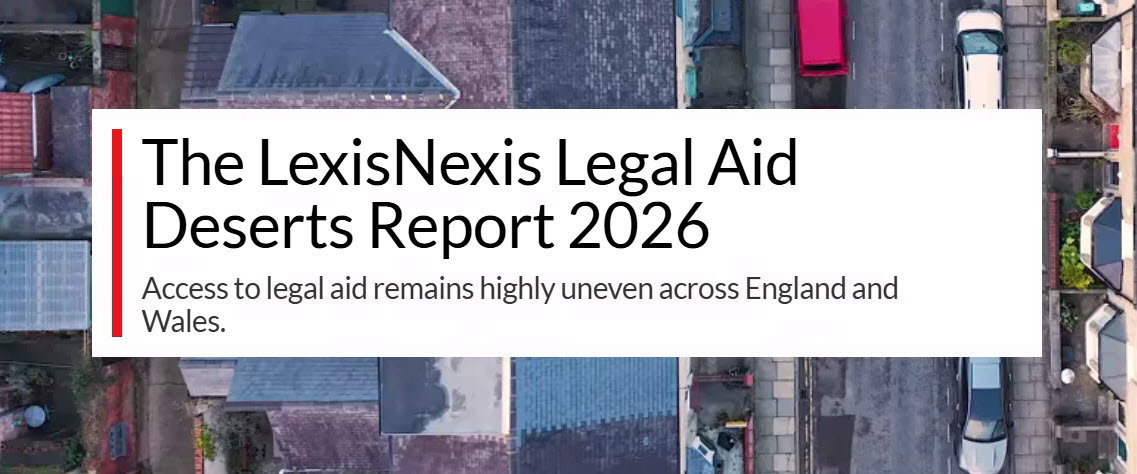
Nearly a quarter of the population of England and Wales lives in an area with high levels of legal need and limited access to legal aid, according to new research by LexisNexis.
The Legal Aid Deserts report estimates that 14.49 million people, or 23% of the population, live in areas classified as legal aid deserts. The research identifies 91 local authorities as falling into this category in at least one of five areas of law: housing, family, crime, immigration and employment.
The analysis found that 4.2 million people live in family legal aid deserts. The equivalent figures were 6.6 million for housing, 3.6 million for crime, 4.6 million for immigration and 4.1 million for employment.
Thirty-seven local authorities, with a combined population of more than five million, were placed in the lowest-scoring category for access in two or more areas. The eight authorities identified as having the weakest provision were Babergh, Breckland, Derbyshire Dales, East Cambridgeshire, East Devon, Rutland, South Norfolk and West Berkshire.
The report found that the weakest-performing areas were concentrated particularly in the East of England, the East Midlands and parts of the South East, with additional pressure points in the South West. It suggests that significant gaps in access are often found in smaller, rural, coastal and semi-rural authorities, where legal aid provider capacity is limited relative to local need.

Kirsty Brimelow KC, Chair of the Bar Council of England and Wales, said legal aid was essential to ensuring access to justice regardless of an individual's financial circumstances. She warned that legal aid deserts could restrict access to early legal advice, contributing to poor case management and delays in proceedings and their resolution.
Jasmine Basran, Head of Policy and Campaigns at Crisis, said access to housing legal aid could be critical in helping people avoid or move out of homelessness. However, she said that legal aid could remain out of reach even where services existed.
The research follows LexisNexis's first Legal Aid Deserts report, published in 2022. Seven of the 15 local authorities with the weakest access to housing legal aid at that time, and eight of the 15 weakest areas for crime legal aid, remain classified as legal aid deserts.
The latest analysis draws on public data relating to legal aid provider locations, population, local authority geography and indicators of legal need. For each area of law, it compares estimated legal need with local provider capacity, adjusted for population, and applies a 15km catchment rule to take account of access to nearby services. Local authorities in the bottom 10% of the resulting access measure are classified as legal aid deserts.